Is the Gulf of Aden safe for shipping? What the Marsa Virgo boarding says about Red Sea risk
Analysis · Armed men boarded a UAE-flagged cargo ship off Yemen on 28 November and were gone within hours. The ship sailed on. Piracy, though, is back on the southern approach to the Red Sea, and ports such as Aqaba are paying for it.

Key points
- Armed men boarded the UAE-flagged Marsa Virgo off Yemen on 28 November; the ship sailed on, but piracy has returned to the Gulf of Aden.
- Navies have shifted to Hormuz and the Iran war, Yemen's conflict has flared and Bab al-Mandeb traffic has fallen to about five ships a day.
- Aqaba handled 14.3% more cargo in the first nine months of 2026, but nearly all its Asian traffic passes Bab al-Mandeb.
- Conflict surcharges and war-risk insurance, not port capacity, now set the cost of trading through Aqaba.
- Assessment to 31 March 2027: continued sporadic piracy 55%, escalation 25%, easing 20%.
On the morning of 28 November armed men climbed aboard the MV Marsa Virgo, a UAE-flagged cargo ship operated by Marsa Ocean Shipping, about 64 nautical miles southwest of Balhaf in Yemen's Shabwah province. The UK Maritime Trade Operations center (UKMTO) at first logged it as a hijack. Later reports said the boarders had gone, the crew was unharmed and the ship was heading on to its next port.
That is as benign as such episodes get, and it would be easy to file it away. The record since the summer argues against doing so. UKMTO has reported a run of boardings and attempted boardings in the Gulf of Aden. In July the tanker Asana was seized off Hadramawt. In August six armed men took the tanker Seamull and steered it towards Somalia. On 17 November gunmen in a skiff tried to board a cargo ship southwest of Mukalla and failed. Somali piracy peaked in 2011, then withered once naval patrols and armed guards on board became routine. It has returned.
Why it is back
The warships have gone elsewhere, for a start. Naval attention in the region has moved to the war with Iran and the Strait of Hormuz. Yemen's conflict has flared again, too. The Houthis now hold the Red Sea coast and the Bab al-Mandeb strait, which they have declared open to everyone except Saudi vessels. Commercial traffic has also thinned sharply: daily transits through Bab al-Mandeb dropped from about 18 in early 2023 to about five this year. A pirate looking for a target faces fewer patrols, and the ships still making the passage are spread more thinly, with less company if something goes wrong.
What it costs Jordan
Aqaba is Jordan's only seaport and a transit gate for Iraq. On paper it is doing well. Cargo handled rose 14.3 percent to 20.51 million tonnes in the first nine months of 2026, and imports climbed 35.3 percent. Some of that growth came from Aqaba serving as an alternative route while Gulf ports were disrupted.
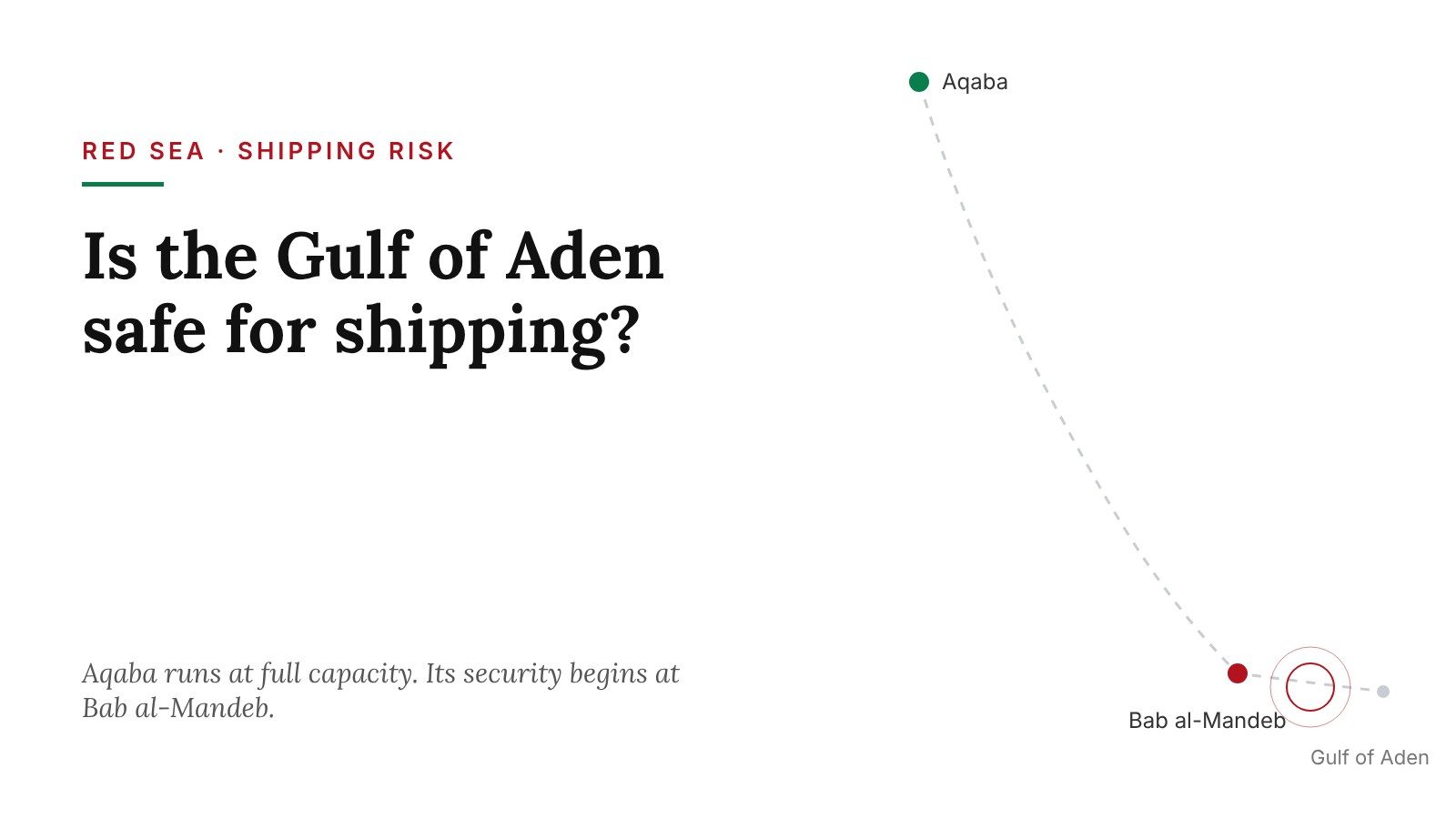
The catch is geography. Nearly all of Aqaba's traffic from Asia has to pass Bab al-Mandeb. Earlier this year shipping lines added emergency conflict surcharges of up to 2,000 dollars per 20-foot container and 4,000 dollars per 40-foot container. War-risk insurance is repriced after each incident. Jordanian consumers end up paying through the cost of imported goods, and Jordanian exporters find it harder to compete abroad.
Capacity is not Aqaba's problem; the port is already handling more cargo than before. What matters now is whether insurers keep covering the route that leads to it, and at what price.
Assessment to 31 March 2027
| Scenario | Likelihood |
|---|---|
| Piracy continues at the current pace: sporadic boardings, most ships pass, costs stay high | 55% |
| Escalation: a successful hijacking with a ransom, or Houthi strikes on shipping, push more lines to suspend Red Sea calls | 25% |
| Easing: a renewed naval presence or a Yemen truce cuts incidents sharply | 20% |
The most likely outcome is expensive but bearable. The danger lies in the tail. A single ransom payment would invite more attempts. Stepped-up Houthi activity would sit on top of the piracy problem, adding to it, and shippers would have to price both at once.
What to watch
- Whether UKMTO reports a hijacked ship being taken to the Somali coast and held there, instead of being released within hours.
- Any move by the EU's Operation Atalanta or other navies to resume patrols in the Gulf of Aden.
- Shifts in war-risk insurance premiums and in the conflict surcharges set by the major container lines.
- Aqaba's monthly container and cargo figures, particularly transit cargo bound for Iraq.