Is Saudi Arabia at risk of partition? What the facts say about the war on its southern border
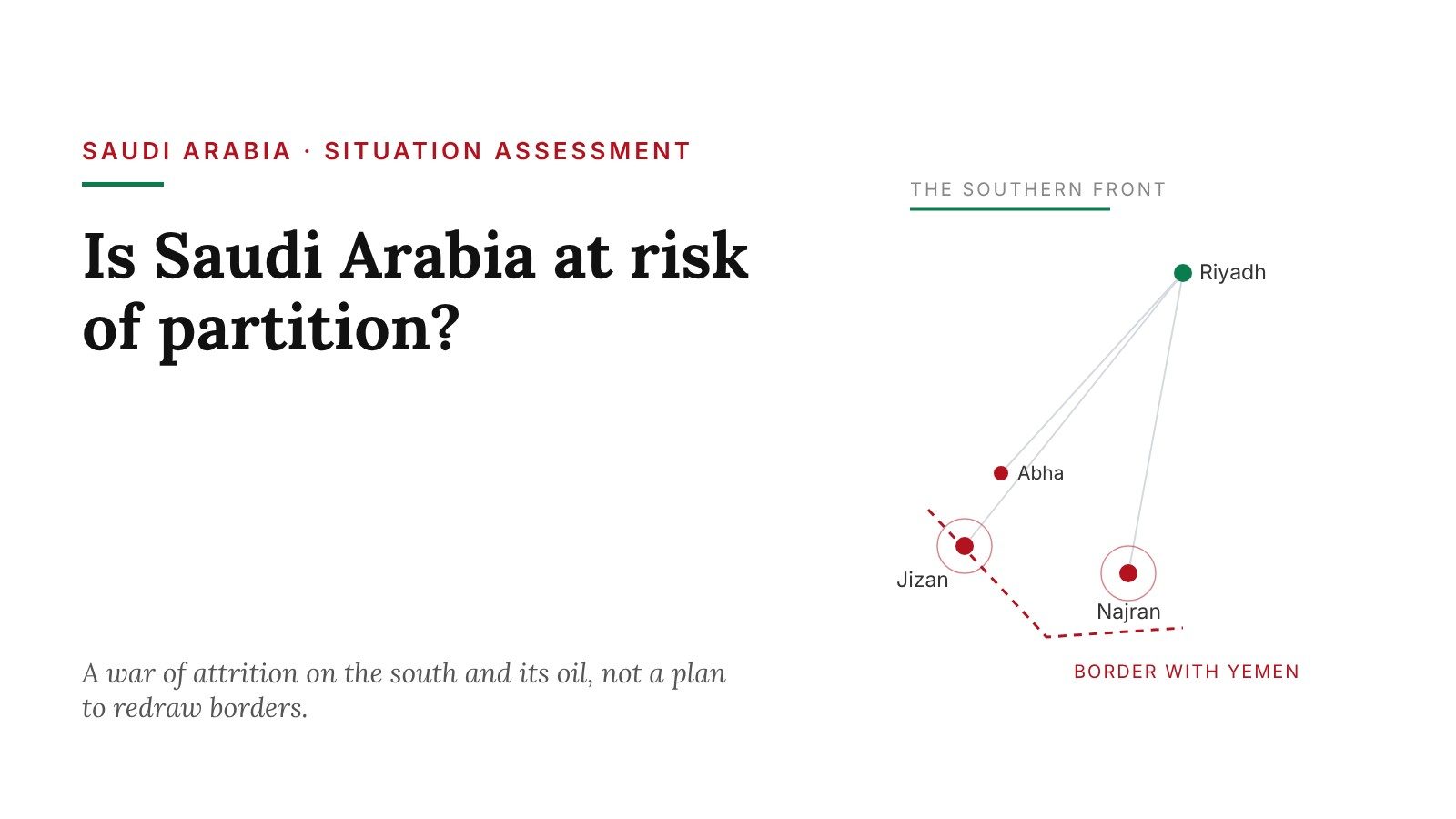
Situation assessment · Every time a missile lands on Jizan or Najran, maps of a "partitioned Saudi Arabia" start doing the rounds on phones again. The facts tell another story: a war of attrition aimed at the kingdom's south and its oil, with no sign of any plan to carve off an inch of its territory.

Key points
- Houthi attacks on southern Saudi Arabia are missile and drone strikes on airports, bases and Aramco sites, not a ground advance or a territorial claim.
- The ground war is inside Yemen, over Hodeidah, Taiz and Bab al-Mandeb, the sea lane for Saudi oil exports.
- The partition maps trace back to a 2006 article by a retired US officer, never an official plan.
- Saudi Arabia was drawn in by converging interests: a US war launched without consulting Riyadh, Iranian pressure through proxies, and a Houthi score to settle.
- Assessment to 30 June 2027: long attrition 60%, a harder settlement 35%, loss of territory under 5%.
Let me be clear: I see no plan to partition Saudi Arabia in what is happening on its southern border. What I see is less dramatic, and more dangerous over time.
The question is still a fair one. Since July, cities in the Saudi south have been hit one attack after another. On 8 September the coalition spokesman, Turki al-Malki, said Houthi strikes had hit Abha, Khamis Mushait, Jizan and Najran, wounding at least 73 people. In October the strikes reached King Khalid airport in Riyadh itself. People are right to be worried.
But I would rather start with a different question: what do the people firing actually want?
What the facts on the ground show
What is hitting the south is missiles and drones. There is no ground advance. No Houthi fighter has crossed the border to hold territory, and the group has laid no claim to sovereignty over Jizan, Najran or Asir. Its declared targets are airports, air bases and Aramco facilities, chief among them the Jizan refinery, which processes about 400,000 barrels a day.
The ground war is being fought inside Yemen. In September the Houthi offensive pushed towards Hodeidah, Taiz and Bab al-Mandeb, the passage through which Saudi oil exports reach the Red Sea, and Riyadh-backed government forces hit back with a counteroffensive in al-Jawf and towards Mocha. The fight, then, is over a sea lane and the balance of power inside Yemen. The kingdom's borders are not part of that equation.
Where the partition idea comes from
Most of the maps now circulating trace back to a 2006 article by a retired American officer in a military journal, which proposed redrawing the borders of the Middle East. It was never an official document, and no government adopted it. Yet it resurfaces with every crisis, because it offers a simple explanation for a complicated event.
Simple explanations are comfortable. They spare us a harder question: how did Saudi Arabia end up in a war it did not choose?
How the kingdom was drawn into this war
Three parties' interests met here, with no single plan binding them.
Start with Washington. The war on Iran began in February without serious consultation with Riyadh, and the US administration has remained reluctant to widen the confrontation with the Houthis. A security partnership built on the promise of reducing the kingdom's exposure has ended up increasing it.
Then Tehran. It scaled back its direct strikes on Saudi Arabia and shifted the pressure onto its allies in Iraq and Yemen, leaving Riyadh squeezed from north and south at once. On 28 February 2026 I wrote a warning about the role of Iraqi militias in this war. Confirmation came in August, when Saudi and US intelligence were reported to have detected plans for attacks coordinated with the Revolutionary Guards and the Houthis.
That leaves the Houthis. On 16 June Abdul Malik al-Houthi declared his movement ready to fight, citing "more than 11 years of aggression and blockade". The spark came on 13 July, when the runway at Sanaa airport was struck just as an Iranian plane carrying a Houthi delegation arrived. A truce that had held for four years collapsed that day.
What we are looking at is a convergence of interests, not a partition conspiracy. The difference matters in practice. A conspiracy assumes a single mind that can be exposed and confronted. A convergence of interests is harder to deal with, because any one party can take a step back while the pressure stays exactly where it is.
Assessment to 30 June 2027
| Scenario | Likelihood |
|---|---|
| Long attrition: intermittent strikes on the south and on oil routes, high economic cost, no change to borders | 60% |
| A settlement with the Houthis on terms harder for Riyadh than those on the table before 2026, through Omani or Iranian mediation | 35% |
| The kingdom loses control of any part of its territory | under 5% |
My specific forecast: the Houthis will not take any Saudi town by mid-2027. Riyadh will, however, enter direct negotiations with them before then, and the "Decisive Storm" image launched in 2015 will pay a higher price in the settlement than it paid in the war itself.
In the nearer term, I expect a notable Saudi move towards the south before mid-January, on two tracks. The first is quiet contact with mediators to stop the strikes. The second is a domestic step that binds the southern regions more tightly to the centre, such as a major development project for Jizan, Najran and Asir, or a change of field commanders followed by relative calm on the front. My reading is that Riyadh understands that protecting its periphery starts with the economy, not air defence.
What to watch
- Any official announcement of a major development or investment project for the Saudi south.
- Changes in field command on the southern front, and whether the tempo of strikes drops afterwards.
- The fate of the Iranian and Omani mediation offers, and any direct Saudi-Houthi meeting that is announced or leaked.
- Continued pressure from Iraqi militias in the north: the kingdom is facing two fronts, not one.
What it means for Jordan
What matters for us goes beyond the maps. A state with Saudi Arabia's size and network of alliances found itself in a war others decided on, and bore the cost almost alone. An alliance with a great power does not guarantee protection. It can make you a target precisely because of that alliance.
There is talk now of moving US forces from the Gulf to Jordan. This is the time to ask, before the moment passes: who decides? And who pays if a front we did not open catches fire?
I do not see Saudi Arabia heading towards partition. I see it on a long and expensive road. The fixation on maps only distracts people from that reckoning.
Related: Should Jordan join the Saudi–Turkish–Pakistani defence pact? · Will the Houthis strike Jeddah? · Did the Houthis hit Ras Tanura?