Can the Gulf keep the taps running if Iran hits desalination plants? What the UAE's east-coast plan tells us
Kuwait and Bahrain have already lost plant capacity to strikes this year. The UAE is now planning plants outside the Gulf. Here is how exposed the region's water really is.

Key points
- We judge it about 40% likely that a Gulf desalination or combined power-water plant is damaged by a strike before 31 January 2027.
- Bahrain and Kuwait plants were hit in March and July 2026; supplies were maintained, but Kuwait asked residents to cut use.
- Kuwait relies on desalination for about 90% of drinking water, from eight plants on the Gulf coast.
- The UAE is studying new plants on its east coast, outside the Gulf, plus larger underground storage.
- Kuwait, Bahrain and Qatar have no coast outside the Gulf; storage, interconnection and air defence are their main options.
On Wednesday 25 November the UAE's Minister of Energy and Infrastructure, Suhail Al Mazrouei, told an energy conference in Ras Al Khaimah that the country is studying new desalination plants on its east coast, outside the Arabian Gulf, and their connection to the national water transmission network. According to the state news agency WAM, the stated aims are more production capacity, more production sites and more water held in underground reservoirs. The announcement came in a week when Iran's Revolutionary Guard claimed strikes on US air-defence radars at Bahrain's Riffa and Awali bases and on Patriot systems at Kuwait's Ali Al Salem air base, and when two senior Arab officials told The National they expect full-scale hostilities between the United States and Iran to resume.
Our assessment: for Kuwait and Bahrain in particular, the water question is now a security question. We judge it about 40% likely that another strike will damage a desalination plant, or a combined power and water plant, in a Gulf Cooperation Council state before 31 January 2027. The Gulf can absorb a single damaging hit, as Bahrain and Kuwait did this year. It cannot absorb a sustained campaign against water infrastructure without rationing. The UAE's east-coast plan is a sound hedge, but it is a multi-year one and does not change the region's exposure this winter.
The short answer
Yes, the taps will keep running through isolated strikes. Plants are numerous, networks are linked, and operators have shown they can keep supplies online after damage. The risk lies in repetition and concentration: Kuwait draws about 90% of its drinking water from eight coastal plants, all of them on Gulf shores within range of Iranian drones and missiles.
What we know
| Report | Source | Rating |
| Bahrain said Iran damaged one of its desalination plants on 8 March; supplies remained online | Bahrain electricity and water authority, via AP | B2 |
| An attack on a Kuwaiti power and desalination plant on 30 March killed one worker; Iran's military command denied responsibility | Kuwait Ministry of Electricity, via Al Jazeera | B2 |
| A July aerial attack set fire to a Kuwaiti power and desalination plant; residents were asked to cut water and electricity use | Kuwait Ministry of Electricity, Water and Renewable Energy, via Al-Monitor | B2 |
| Kuwait meets about 90% of drinking water demand from desalination, with eight major plants and more than 2.2 million cubic metres a day of capacity | World Population Review data, via Al-Monitor | C3 |
| Desalination supplies a combined 62 million people across the six GCC states | TIME | C3 |
| The UAE is studying east-coast plants outside the Gulf and larger underground storage | Minister Al Mazrouei, via WAM and The National | A2 |
Why the exposure is real
Three facts drive our judgement. First, desalination plants have already been hit in this war, and in two cases the plant was a combined power and water facility. Whether the water units were the intended target matters less than the outcome: a strike on a generating station adjacent to a desalination unit can take both offline. Second, Iranian fire at Gulf states has not stopped. In the week to 22 November the Revolutionary Guard claimed strikes on bases in Bahrain and Kuwait, and an ADNOC Logistics vessel was attacked in the Strait of Hormuz on 17 November, leaving one crew member missing and 11 injured. Third, both sides have put water on the target list in rhetoric. President Trump has threatened Iran's desalination plants, and Iran's foreign minister has accused the United States of cutting water to 30 villages on Qeshm Island. That exchange lowers the political cost of hitting water infrastructure.
The restraining factors are also real. Iran's recent strikes have been aimed mainly at US military assets, not civilian utilities. Bahrain and Kuwait have reported intercepting most of the latest drone attacks. And President Trump has said the US military campaign is funded only until the end of January, with Democrats taking control of Congress that month, which may narrow the window for a wider escalation.
What the UAE plan does, and does not do
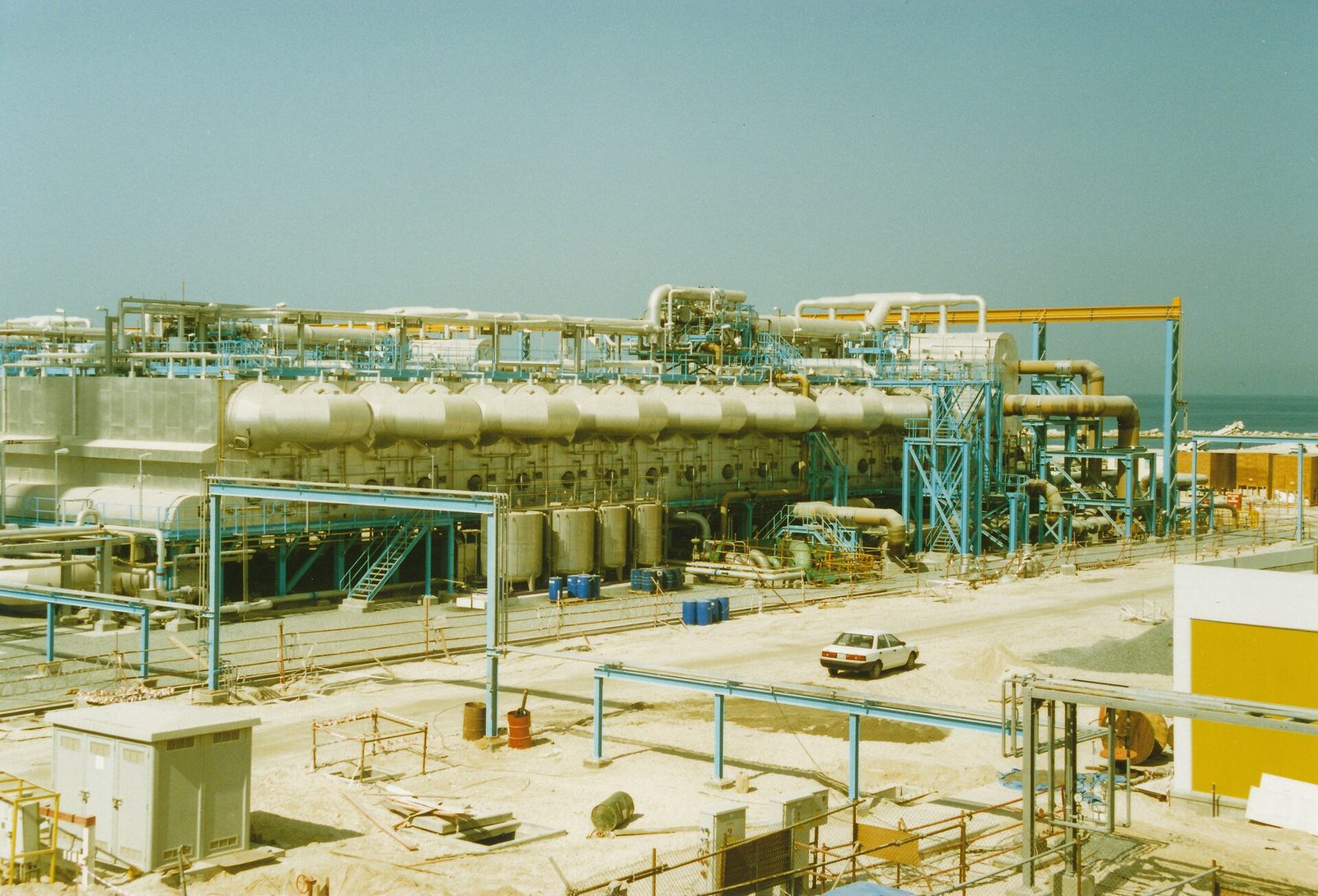
Building on the Gulf of Oman coast moves production away from the waters where tankers have been mined and struck. The UAE already has a precedent: the Fujairah I plant at the Port of Fujairah, agreed in May 2026, will produce 60 million imperial gallons a day by seawater reverse osmosis at a cost of Dh1.046 billion ($284.8 million). Linking such plants to the national grid, and storing water underground, gives the federation days or weeks of cover if a Gulf-coast plant goes down.
The limits are clear. New plants take years to procure and build. The east coast is not beyond reach; recent tanker incidents have occurred off Khasab and Musandam, close to the Gulf of Oman. And the UAE's geography is unusual. Kuwait, Bahrain and Qatar have no coastline outside the Gulf, so they cannot copy the model. Their options are storage, interconnection with neighbours and air defence around plants.
Scenarios to 31 January 2027
- Contained exposure (60%). Strikes continue against military targets; no desalination plant is damaged. Gulf states accelerate storage and procurement quietly.
- A single damaging strike (30%). One plant in Kuwait or Bahrain is hit, supply is maintained through the network and conservation appeals, and repairs take days to weeks.
- A campaign against water infrastructure (10%). Full-scale hostilities resume and several plants are struck in sequence, forcing rationing in at least one GCC state.
What to watch
- Whether US-Iran fighting resumes after the funding deadline at the end of January.
- Any Kuwaiti or Bahraini call for residents to reduce water use, the earliest public sign of strain.
- A tender or site announcement for the UAE's east-coast plants, which would show how fast Abu Dhabi intends to move.
- Gulf procurement of point air defence for utilities, as distinct from military bases.
What it means for institutions
Companies with staff or operations in Kuwait and Bahrain should check site water storage and contingency supply now, not after a strike. Investors in Gulf utilities should expect higher spending on storage, redundancy and protection, and should treat east-coast and inland projects as the growth segment. Insurers will price water and power assets on the Gulf coast as front-line infrastructure for as long as the war lasts.
We will update this assessment after the end-January funding deadline, or earlier if a desalination plant is struck.